




Scout Agent for Evidence-Backed B2B Sales Research
Scout is an AI-assisted account research workspace that turns a natural-language ICP into a ranked, evidence-backed B2B shortlist. It confirms company identity and official domains before scoring each prospect against explicit criteria, then surfaces public signals, fit rationale, pain hypotheses, outreach angles, and the gaps that still need human review. Prepared synthetic scenarios make the workflow instantly explorable, while custom searches run asynchronously and deliver a protected report link to the submitted business email.
 React
React TypeScript
 Python
 FastAPI
 OpenAI
About the project
The Product: Scout is a standalone B2B account discovery and qualification workspace for sales and growth teams. It replaces fragmented prospect research with one guided flow: describe an ideal customer profile, review a ranked shortlist, inspect why each account matched, and decide what still needs validation before outreach.
What it Does: Users can explore prepared synthetic scenarios immediately or submit a custom ICP for live public-web research. Each report combines normalized account criteria, qualification status, fit scores, business signals, pain hypotheses, outreach angles, public-source evidence, available work contacts, and clearly labeled missing data — without presenting uncertain findings as fact.
How it Works: A React and TypeScript frontend connects to a FastAPI service and an asynchronous single-concurrency Scout worker. The pipeline normalizes explicit ICP criteria, uses Codex Native Web Search to propose typed company entities, independently fetches and validates every official and evidence URL through an SSRF-safe public-page boundary, resolves employer identity, and scores up to three confirmed companies within bounded search and processing limits.
Why It Is Different: Scout treats AI output as a proposal, not as evidence. Company identity is confirmed before scoring, every explicit criterion can be marked passed, failed, or unknown, and unknown data never earns points. Public work contacts appear only when a source supports them and the email matches the company domain; emails and phone numbers are never guessed.
Secure Delivery: Custom searches move immediately to a UUID tracking route with honest queued and running states. Report content stays unavailable until SMTP accepts a short notification sent only to the submitted business email. The email contains no prospect data; instead, it carries a reusable 14-day URL whose fragment holds a tamper-resistant token bound to the run.
Privacy by Design: Raw ICP text and the recipient email live only in a run-scoped SQLite file during processing and delivery, while the global queue stores UUIDs and one-way rate-limit digests rather than raw input. Public fetching rejects local and private network targets, caps redirects and response sizes, and treats all discovered page content as untrusted. Prepared examples remain explicitly synthetic and can never be substituted for a failed custom run.
Learn tech information for this project
About the project
The Product: Scout is a standalone B2B account discovery and qualification workspace for sales and growth teams. It replaces fragmented prospect research with one guided flow: describe an ideal customer profile, review a ranked shortlist, inspect why each account matched, and decide what still needs validation before outreach.
What it Does: Users can explore prepared synthetic scenarios immediately or submit a custom ICP for live public-web research. Each report combines normalized account criteria, qualification status, fit scores, business signals, pain hypotheses, outreach angles, public-source evidence, available work contacts, and clearly labeled missing data — without presenting uncertain findings as fact.
How it Works: A React and TypeScript frontend connects to a FastAPI service and an asynchronous single-concurrency Scout worker. The pipeline normalizes explicit ICP criteria, uses Codex Native Web Search to propose typed company entities, independently fetches and validates every official and evidence URL through an SSRF-safe public-page boundary, resolves employer identity, and scores up to three confirmed companies within bounded search and processing limits.
Why It Is Different: Scout treats AI output as a proposal, not as evidence. Company identity is confirmed before scoring, every explicit criterion can be marked passed, failed, or unknown, and unknown data never earns points. Public work contacts appear only when a source supports them and the email matches the company domain; emails and phone numbers are never guessed.
Secure Delivery: Custom searches move immediately to a UUID tracking route with honest queued and running states. Report content stays unavailable until SMTP accepts a short notification sent only to the submitted business email. The email contains no prospect data; instead, it carries a reusable 14-day URL whose fragment holds a tamper-resistant token bound to the run.
Privacy by Design: Raw ICP text and the recipient email live only in a run-scoped SQLite file during processing and delivery, while the global queue stores UUIDs and one-way rate-limit digests rather than raw input. Public fetching rejects local and private network targets, caps redirects and response sizes, and treats all discovered page content as untrusted. Prepared examples remain explicitly synthetic and can never be substituted for a failed custom run.
Learn tech information for this project
Scout Agent
AI-assisted B2B account discovery with explicit scoring, public evidence, visible uncertainty, and protected report delivery.
ReactTypeScriptPythonFastAPIOpenAIScout Agent
AI-assisted B2B account discovery with explicit scoring, public evidence, visible uncertainty, and protected report delivery.
ReactTypeScriptPythonFastAPIOpenAI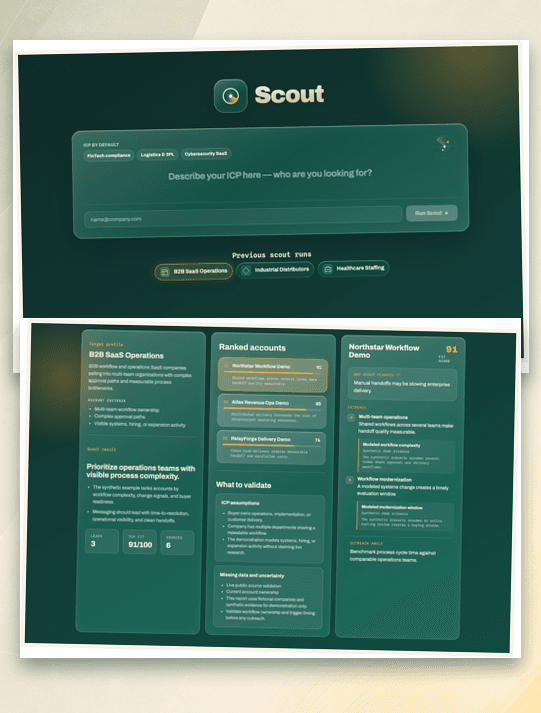
Features
ICP-to-Account Flow
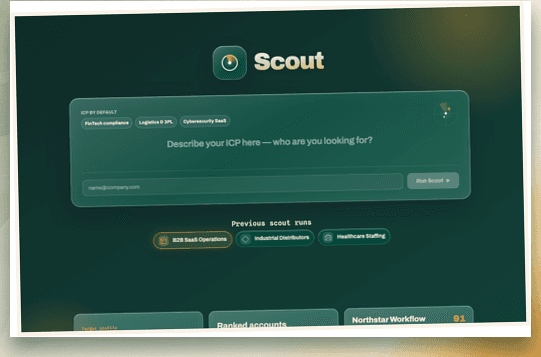
Scout starts with the way sales teams already describe market fit: a concise natural-language ICP. Prepared profiles demonstrate complete use cases without external provider calls, while the custom command validates a business email and a focused ICP before creating a live research run. The same workspace keeps target criteria, shortlist metrics, ranked accounts, and account analysis in one continuous narrative.
For live searches, the backend separates hard filters, qualifying signals, and non-scored solution themes before discovery begins. The resulting report ranks up to three independently confirmed companies and makes the methodology visible, so users can understand why an account surfaced instead of trusting a black-box recommendation.
Evidence-First Scoring
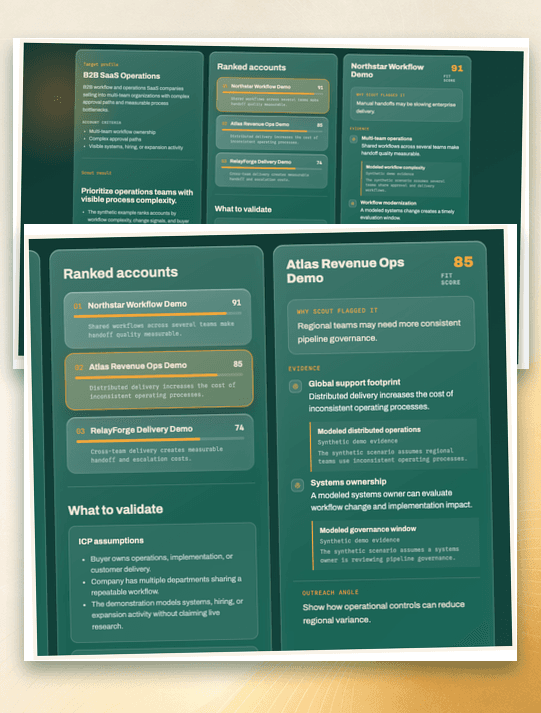
Every ranked account opens into a structured dossier with an overall fit score, explicit criterion outcomes, supporting business signals, a pain hypothesis, and a practical outreach angle. Source cards sit next to the claims they support, while unknown criteria and missing data remain visible as review items rather than being silently converted into confidence.
Scout resolves company identity before analysis. Direct company pages keep their public host, while job-board and ATS signals require a confirmed employer name and matching official domain. Proposed URLs are fetched independently through DNS-pinned, SSRF-safe validation, and unresolved companies are discarded. Public work emails are included only when a source supports them and the address matches the confirmed company domain.
Secure Tracked Delivery
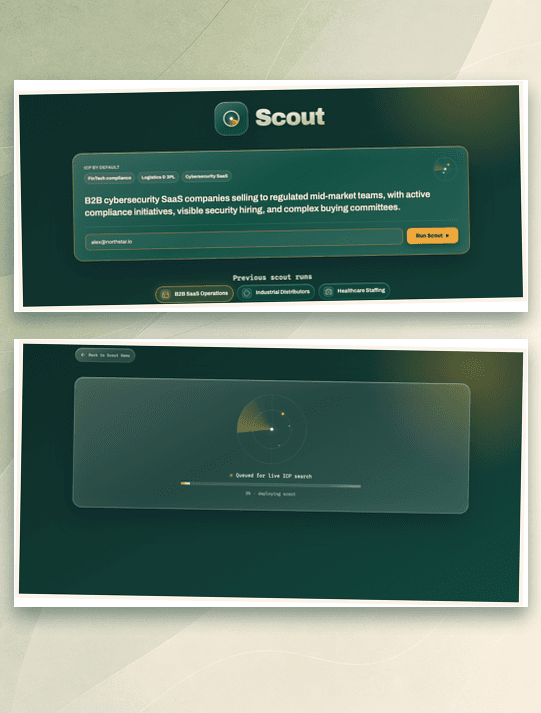
A custom submission returns immediately with a UUID and opens a dedicated tracking route. Queue position, processing stage, progress, and terminal outcomes stay honest throughout the bounded asynchronous run: completed and partial reports remain distinct, while failed or timed-out searches never fall back to a polished fixture.
When research finishes, Scout sends only the submitted business email a short notification with a protected 14-day report link. The report itself and its public sources are never placed in the email. A tamper-resistant fragment token unlocks the report and its context-only assistant APIs, while raw ICP and recipient data are removed after delivery completes or reaches a terminal failure.
Features
ICP-to-Account Flow
Scout starts with the way sales teams already describe market fit: a concise natural-language ICP. Prepared profiles demonstrate complete use cases without external provider calls, while the custom command validates a business email and a focused ICP before creating a live research run. The same workspace keeps target criteria, shortlist metrics, ranked accounts, and account analysis in one continuous narrative.
For live searches, the backend separates hard filters, qualifying signals, and non-scored solution themes before discovery begins. The resulting report ranks up to three independently confirmed companies and makes the methodology visible, so users can understand why an account surfaced instead of trusting a black-box recommendation.
Evidence-First Scoring
Every ranked account opens into a structured dossier with an overall fit score, explicit criterion outcomes, supporting business signals, a pain hypothesis, and a practical outreach angle. Source cards sit next to the claims they support, while unknown criteria and missing data remain visible as review items rather than being silently converted into confidence.
Scout resolves company identity before analysis. Direct company pages keep their public host, while job-board and ATS signals require a confirmed employer name and matching official domain. Proposed URLs are fetched independently through DNS-pinned, SSRF-safe validation, and unresolved companies are discarded. Public work emails are included only when a source supports them and the address matches the confirmed company domain.
Secure Tracked Delivery
A custom submission returns immediately with a UUID and opens a dedicated tracking route. Queue position, processing stage, progress, and terminal outcomes stay honest throughout the bounded asynchronous run: completed and partial reports remain distinct, while failed or timed-out searches never fall back to a polished fixture.
When research finishes, Scout sends only the submitted business email a short notification with a protected 14-day report link. The report itself and its public sources are never placed in the email. A tamper-resistant fragment token unlocks the report and its context-only assistant APIs, while raw ICP and recipient data are removed after delivery completes or reaches a terminal failure.
Contact Us






Anastasia Timoshenko
Regional Account Manager
1000+
Delivered projects
300+
Clients worldwide
700+
In-house developers
28+
Years in industry


 5.0 Ratings